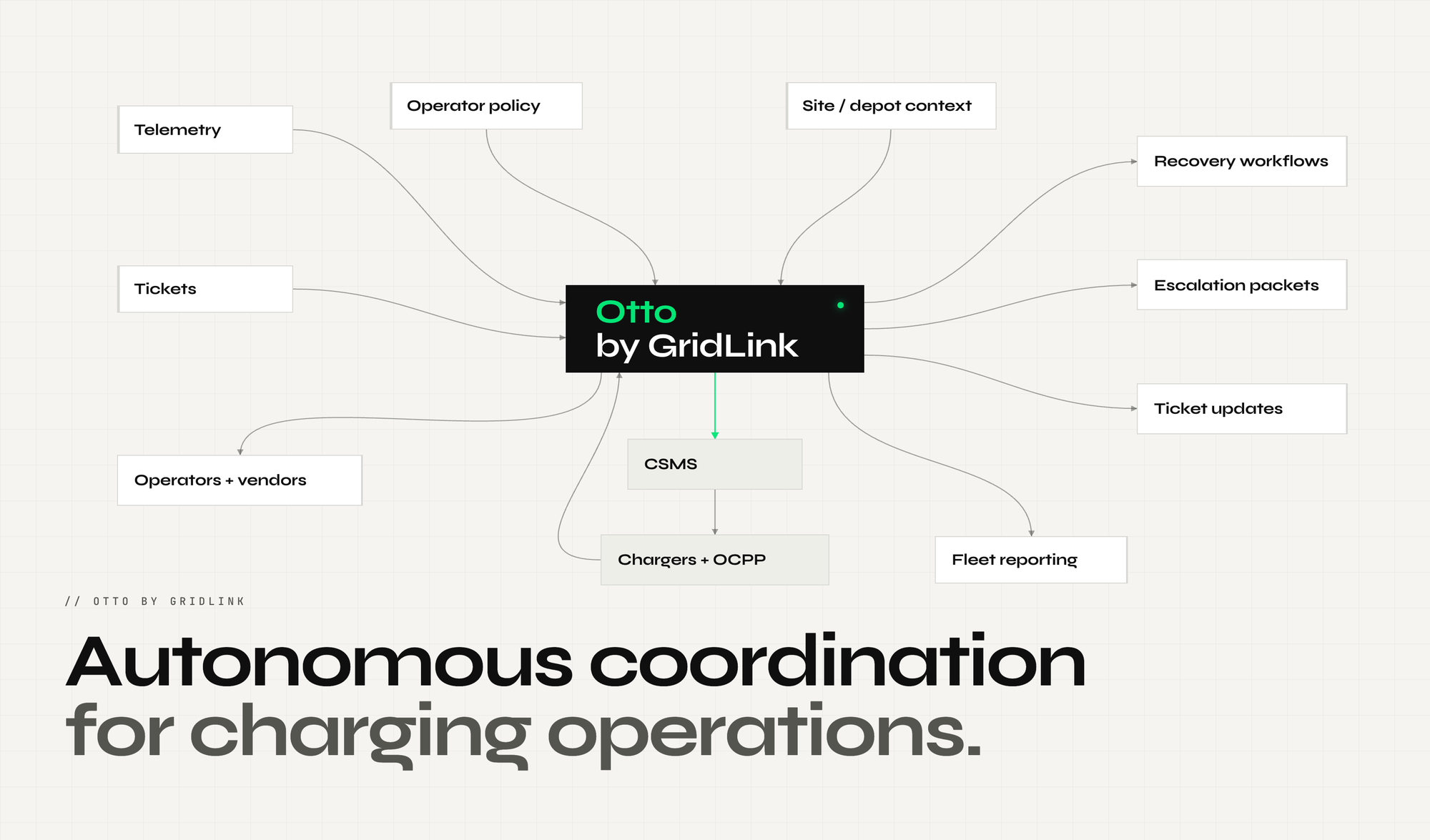
Today we're launching Otto: an autonomous charging reliability service by GridLink. Otto detects, diagnoses, fixes, and escalates issues that operators handle by hand today, across the chargers, software, and ticketing they already run.
We built it the slow way. For the past year, although it wasn't the core part of our software business, we've also been running a network operations center for chargers. That meant watching live sessions, fielding driver complaints, and coordinating with charger and vehicle engineers when something misbehaved.
The surprising part was not that charging operations required people. It was how much of the work was repeatable.
A session would fail to start. An operator would pull the recent Open Charge Point Protocol (OCPP) messages, check the handshake, and run the known recovery. A charger would derate. Someone had to decide whether the issue was the vehicle, the charger, the site configuration, or the charging station management system (CSMS). A fault would fire. The code alone rarely said enough.
That's playbook work, and a lot of it can be automated. Otto is what we built to run those playbooks at scale.
What We Saw Running Charging Operations
Under a grant from the Michigan Office of Future Mobility and Electrification, we spent the past year running and building this stack in production, across a wide variety of vehicle and charger setups.
Many of these failures only surface if a human reads the OCPP stream line by line, looking for the place where the story stops making sense. To anyone else, the traffic reads as healthy.
Reported network uptime sits at 95–99% [1]. Depending on the studies you read, first-try session success is closer to 86% [2][3], falling below 70% by year three [4]. More than 90% of those failures are software and connectivity, not broken hardware [5].
One in seven sessions fails on the first try. More than 80% of those failures are software, not hardware. Most operators are still handling them by hand.
In our own NOC work with Otto this year, the share resolved without dispatching a technician has trended higher still.
What Otto Does
Otto reads from the chargers, software, telemetry, and ticketing systems operators already use, and works five surfaces:
Detect. Watch the OCPP stream for failed starts, stale telemetry, ambiguous fault codes, derates, and the patterns operators would otherwise have to catch by hand.
Diagnose. Classify the failure against charger model, firmware, vehicle, and site context. Pull the messages that prove it.
Act. Run approved recovery: retries, resets, configuration checks, ticket updates, multi-step remediations.
Escalate. Route the right evidence to the right person when automation shouldn't act alone. A technician, vendor engineer, or internal operator shouldn't have to reconstruct the failure from scratch.
Analyze. Surface recurring failure modes, underutilized chargers, repeated fault classes, and operational patterns before they become issues operators stop questioning.
Where Otto Fits
Otto is a new category of software for EV charging. The CSMS manages chargers. Otto automates the operational work around them; it sits alongside the CSMS and the rest of the operating stack.
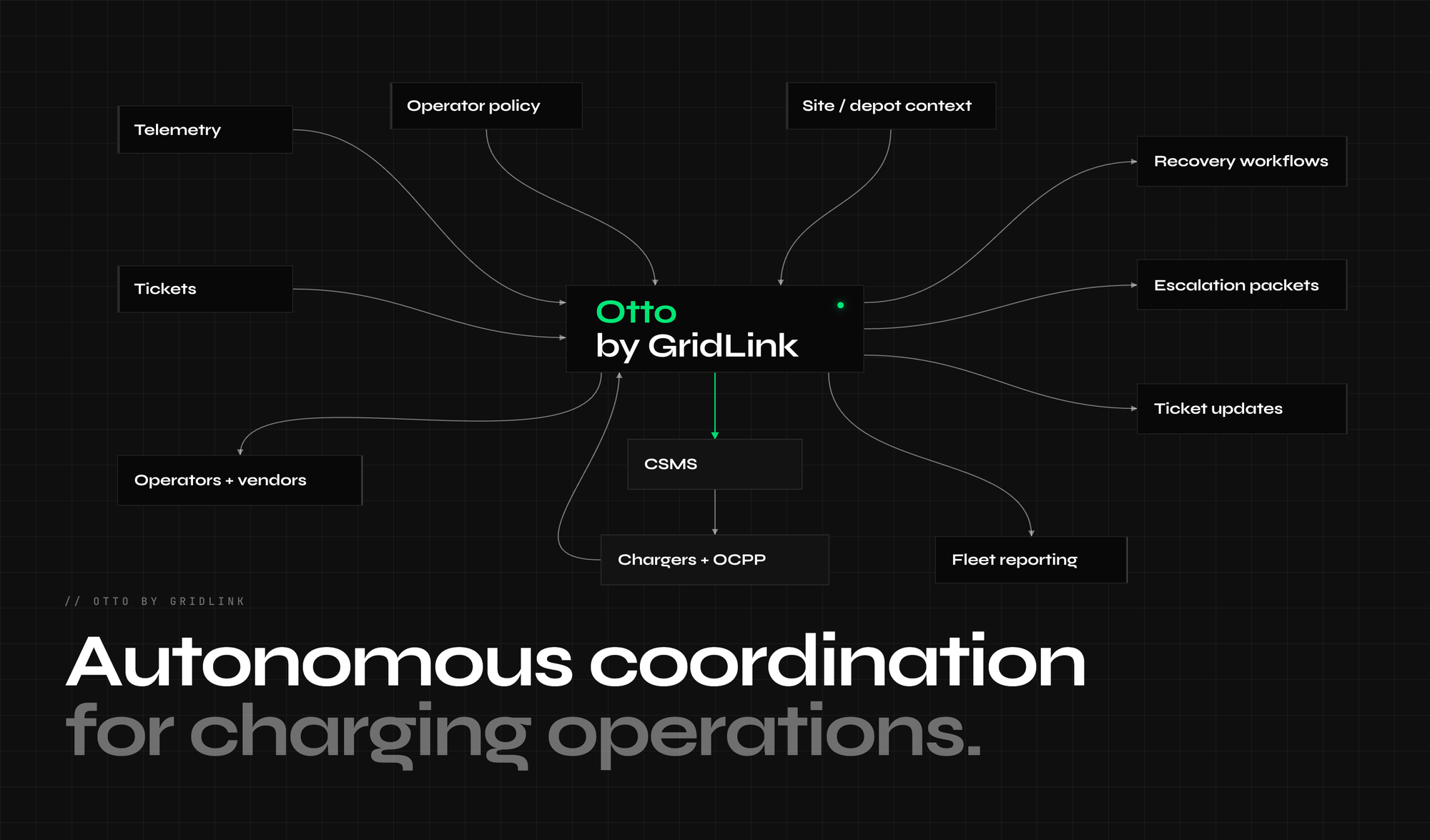
Each workflow from Otto encodes a playbook your team would otherwise run by hand, applied consistently across the conditions and constraints that actually fire it.
Available Today
Otto is live today for select partners, starting with reliability remediation for teams running it by hand today. The same layer extends to reporting, configuration checks, underutilization analysis, vendor escalation, and site-policy enforcement.
Vertically integrated operators solved this years ago, inside their own stacks. Otto is the same capability for everyone else, without asking you to rip out what you already run.
If too much of your charging ops work lives in dashboards, spreadsheets, fragile scripts, and people's heads, Otto fits alongside your existing stack.
References
Reported uptime remains high across leading networks. Tesla's Supercharger network maintains around 99.95% uptime (Destination Charged, 2026). EVgo claims 98% (EVgo), ChargePoint averages ~96% across its network and offers 98% under its Assure tier (ChargePoint, 2024). The federal NEVI program requires 97% uptime for federally funded chargers. ↩︎
First-try session success runs well below reported uptime. The 2025 Vecharged Public EV Charger Reliability Report finds an 86% national session success rate, meaning roughly one in seven public charging attempts fails on the first try (Vecharged, 2025). ↩︎
Owner-reported failed visits track the same gap. J.D. Power's 2025 U.S. Electric Vehicle Experience Public Charging Study found 14% of public-charging visits ended without a successful charge, improved from 19% in 2024 but still roughly one in seven (J.D. Power, 2025). ↩︎
Reliability degrades with infrastructure age. ChargerHelp's 2025 Annual Reliability Report, covering more than 100,000 sessions across 2,400 chargers, finds first-time charge success drops from roughly 85% at new stations to under 70% by year three, a gap traditional uptime metrics fail to capture (ChargerHelp, 2025; summary). ↩︎
Most charger failures are software and communication issues, not broken hardware. The Electrification Institute's Electrification 2030 study of U.S. charging-network data attributes session failures roughly as 55% station connectivity and authentication, 38% internal station faults (software and some hardware features), and 4% connector or cable, together placing more than 90% of failures outside the category of pure physical damage (Electrification Institute via Qmerit; Energy Tech summary). ↩︎
Automated remediation is being formalized as an industry pattern. The Joint Office of Energy and Transportation's ChargeX Consortium, a partnership of the National Renewable Energy Laboratory, Idaho National Laboratory, and Argonne National Laboratory with EVSE manufacturers, network operators, and automakers, published the Seamless Retry recommended practice in December 2024 and updated it in September 2025, formalizing the pattern of automatically resetting and retrying failed charging sessions without driver intervention (Joint Office, 2025; NREL ChargeX, 2025; INL recommended practice). ↩︎